Wohnen · 6 min
Living in Vienna with a child for a while, how to recognise a good home
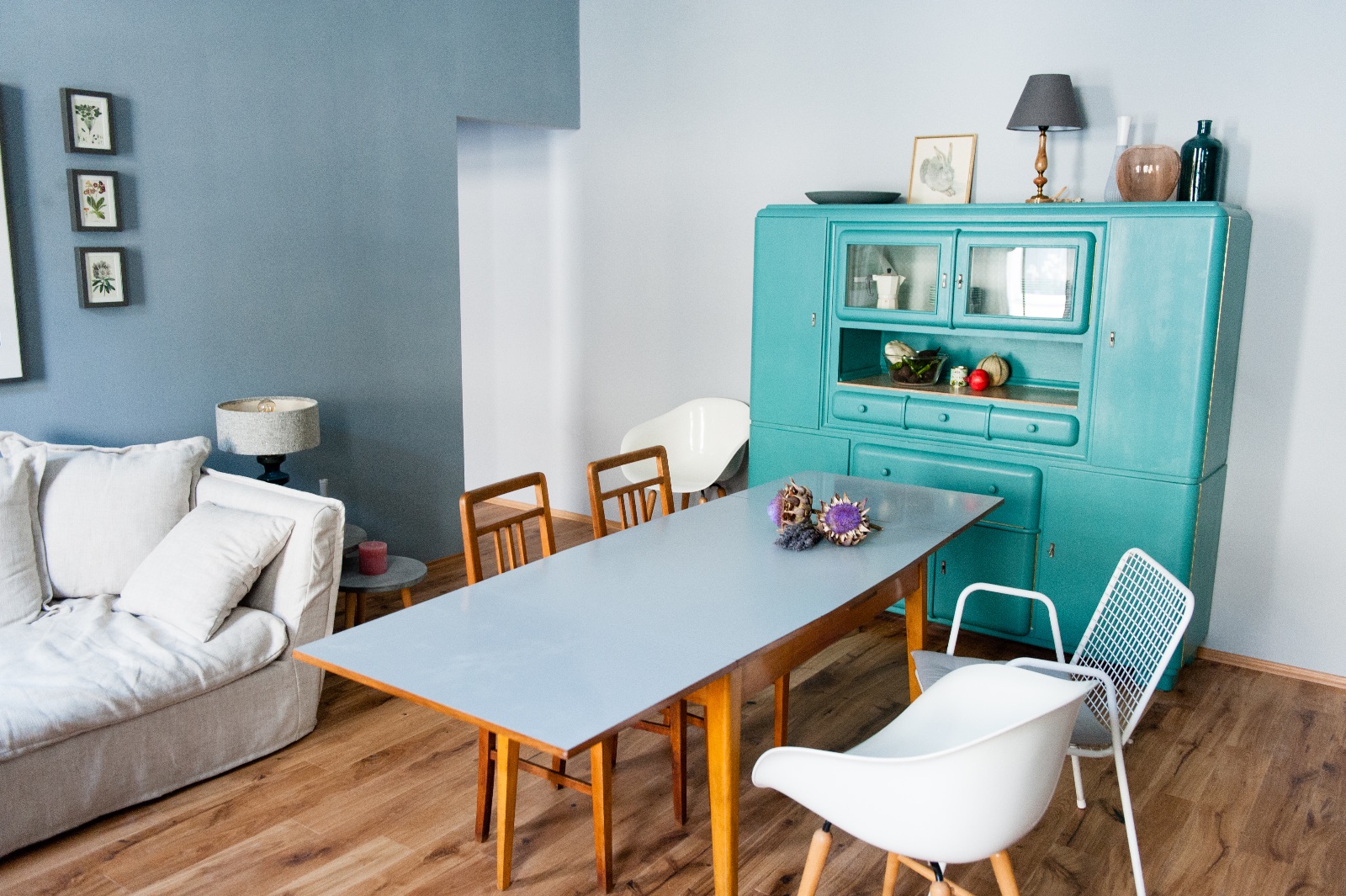
Two small thistles lie in the middle of the light grey tabletop, one violet, one dried, as if a child had brought them home from a walk and forgotten them there. Beside them sit chairs that do not match, a turquoise cabinet from the fifties, a sofa with a pale cover you are allowed to sink into. This is what a room looks like where a family can arrive. If you want to live in Vienna with a child for a while, it comes down to exactly these kinds of rooms. Not about making an impression, but about the question of where your child kicks off their shoes after school and where you sit together at the table in the evening.
Space that means more than square metres
A temporary family home needs space, but space does not simply mean a big number in the listing. It means there is a place where everyone comes together, and one where each person can withdraw. In the first room stands a long dining table with a light grey top on slim oak legs, four chairs around it, no chair like the next. That is not a lack of uniformity, that is character. A child picks out a favourite chair, an adult sits down beside them, and just like that the room has an order no one had to impose.
When living somewhere temporarily with a child, look for a clear dining area, separate from the sofa but within the same line of sight. You cook, your child draws at the table, and you are still in the same room. This short distance between kitchen and table is worth more in everyday life than any square metre that serves only as a passage. Good homes think the path from stove to plate all the way through.
Quiet, and specifically separate quiet
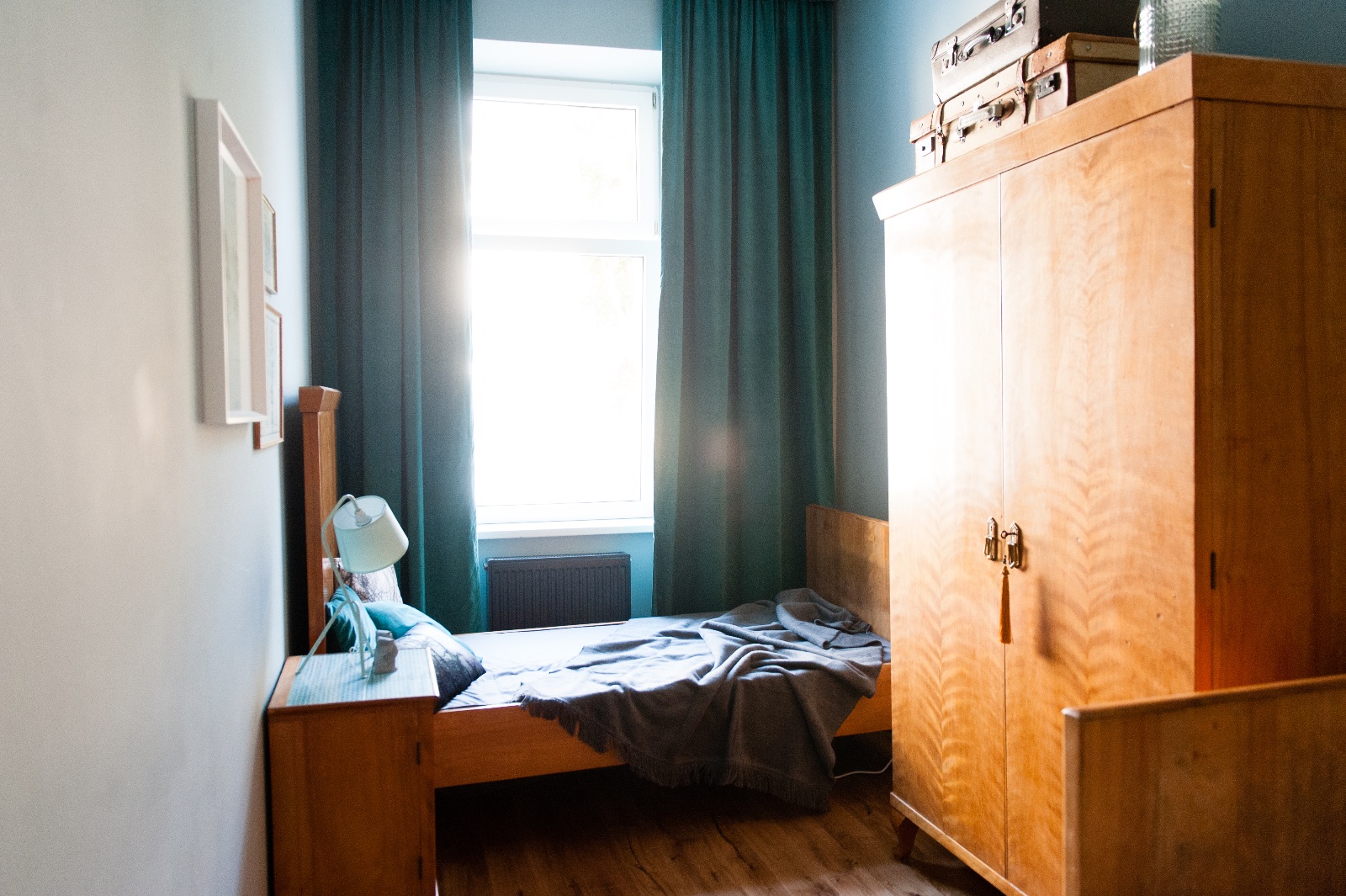
A family needs two kinds of quiet. The shared kind in the evening and the separate kind, when the child is already asleep and you are still awake. That is why it pays to look closely at the bedrooms. In the second picture stands a narrow bed of oiled wood with a high headboard, a coarse grey blanket thrown loosely over it. Beside it a solid wooden cabinet with brass fittings, an old travel trunk on top. A child's room does not have to be colourful. It has to be its own. Its own bed, its own window, its own cabinet where things find their place.
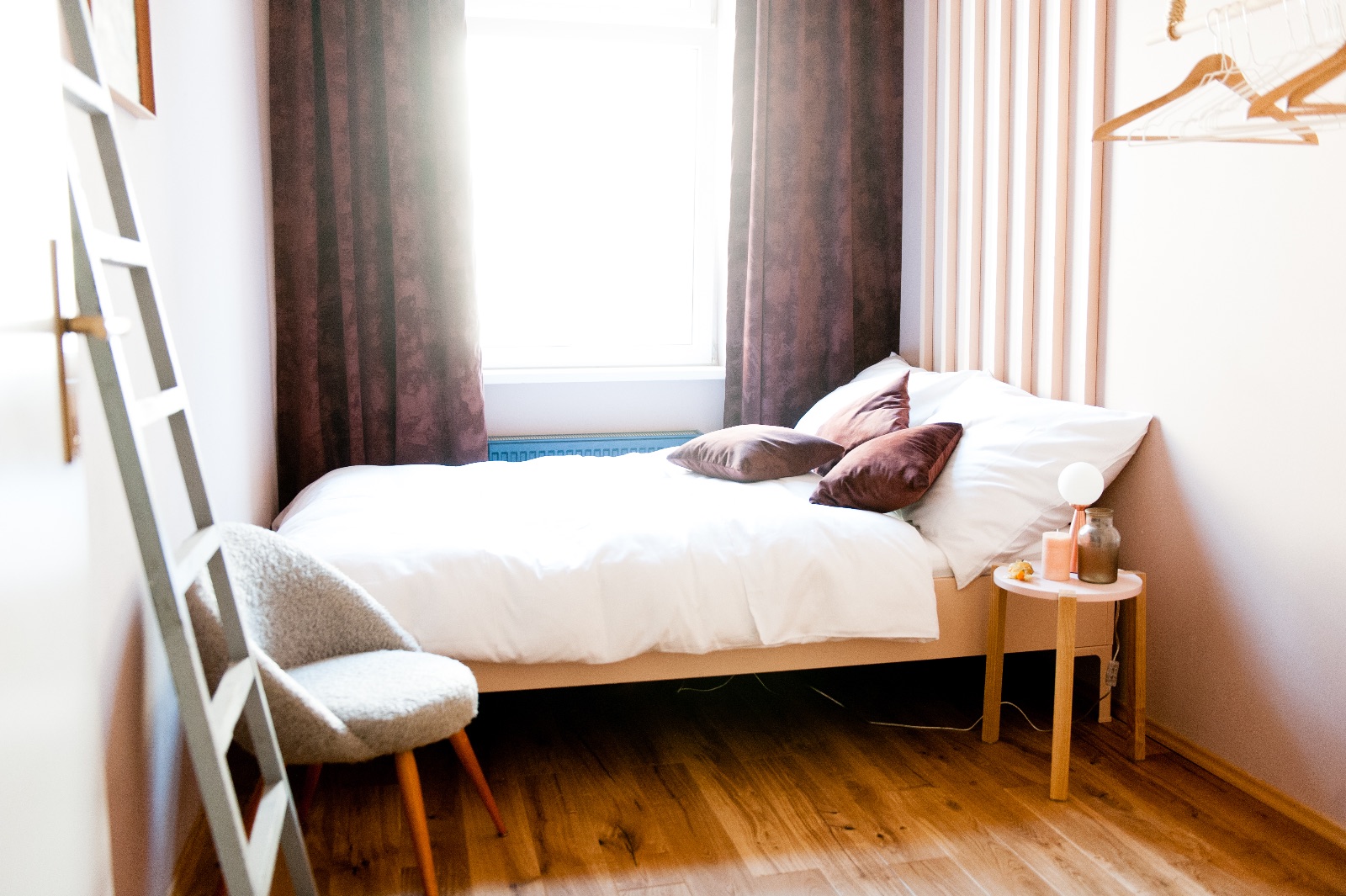
The third room speaks of what parents need. A wider bed with white linen, two cushions in muted dusty rose and brown, a small round bedside lamp with a concrete base. A bouclé chair stands beside it, a place to sit that is not the bed. When you live in Vienna with a child for a while, this chair is no luxury. It is the assurance that you still have a place when the child lies sick in the big bed and you want to stay close all the same.
Ask the concrete questions while you search. Are the bedrooms separated from each other or do they flow into one another. How thick are the walls in an old building, how much sound carries through the courtyard. An honest answer to that tells you more than any photo.
Short distances, the underrated family criterion
With a child, every distance counts twice. The way to school in the morning, the way to the playground in the afternoon, the way to the baker when the bread runs out on a Sunday. A temporary home is only as good as what lies outside the front door. Before you commit, walk the area once on foot, ideally at the time you will be out and about later on. Where is the nearest park. How loud is the street at eight in the morning. Is there a corner shop still open when you are running late.
Short distances are also a question of nerves. A tired child cannot manage half an hour of the walk home. A good family home sits so that the important things are reachable within ten minutes on foot. That takes the pressure out of every day. You do not have to plan everything in advance, because in a pinch you can simply step out for a moment.
A Graetzl where families live well
Vienna divides into Graetzl, small neighbourhoods each with their own character. Some are loud and nocturnal, others quiet and long settled. For families the latter is what counts. A Graetzl where families live well shows itself in small things. Prams outside the cafés, a playground that is not deserted, an innkeeper who knows the regulars by name. You cannot read such quarters off a listing, you have to feel them.
Walk through the streets on a weekday in the late afternoon. Who is out and about. Are parents collecting their children, are people sitting outside, can you hear voices from the courtyards. A lively but not hectic Graetzl gives your family a frame in which routine can take shape. And routine is what children need most in an unfamiliar city. The same path, the same corner, the same face behind the counter.
If you are travelling with your team rather than your family and looking for a place where people arrive together, the same principle holds at a different scale. How a room of material, light and attitude connects people, that is also the heart of our design weekends for companies.
Furniture with patina, because children can be hard on it
A furnished family apartment in Vienna should have furniture that has already lived a little. Vintage pieces with patina, oiled wooden floors, a cabinet that does not mind one more scratch. That sounds like a compromise, but it is the opposite. Furniture with a history is more relaxed to live with than anything that gleams and insists on being flawless. No one breaks into a panic when a child runs a chair into the table.
The turquoise cabinet in the first picture, the wooden hangers on the string, the travel trunk on the cupboard, the lamp with the concrete base. These are not decorative pieces, these are things that are allowed to be used. A home where you do not dare touch anything is the wrong home for families. Look for rooms that are robust and warm at once. Wood, linen, wool, ceramic. Material that is allowed to age and grows more beautiful as it does.
What to watch for before you commit
Ask the uncomfortable questions before you move in. Is there enough storage for toys and school things, or will everything soon be lying around. Is the kitchen equipped so you can really cook, not just make coffee. Does the internet work reliably enough for homework or working from home. How quickly can someone be reached when something breaks.
And then the feeling. Walk through the empty rooms and picture your everyday life. Where does the school bag stand in the morning, where does the jacket hang, where do you sit for breakfast on a Sunday. If these images come easily, the home is right. Living in Vienna with a child for a while means, in the end, finding a place that no longer feels strange after a short while. The rest follows once the foundation is right.
Frequently asked
What does a temporary family home in Vienna really need?
Enough space for togetherness and retreat, separate bedrooms, a kitchen you can cook in, plenty of storage and short distances to school, park and corner shop. More important than pure square metres is how well the rooms sit in relation to one another.
Which Graetzl in Vienna is suited to families?
A Graetzl that is lively but not hectic. Look for playgrounds within walking distance, quiet courtyards, a corner shop nearby and families in the street scene. It is best to walk the area on a weekday afternoon, when you can feel the everyday rhythm.
Are vintage pieces a good idea with children?
Yes. Furniture with patina is more relaxed in daily life than flawless new pieces. Wood, linen and ceramic can take a knock, and no one has to worry over every scratch. Robust and warm at once is exactly right for families.
How long does temporary living with a child in Vienna usually last?
It ranges from a few weeks for a project to several months for a longer stay. What matters is that routine can take shape quickly for the child, the same path, the same playground, the same familiar corner.